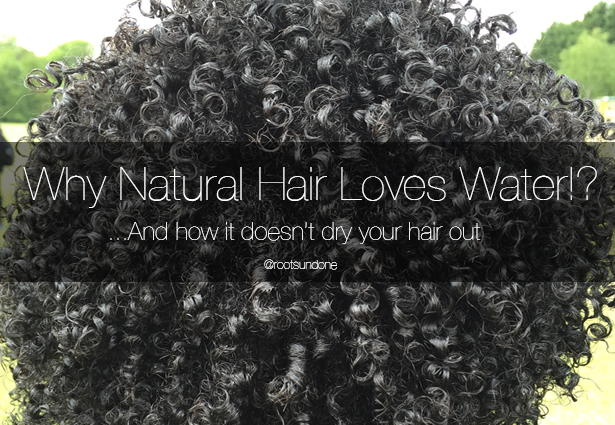
Growing up we were always taught to keep our hair away from water and that contact with water will cause shrinkage, dryness and breakage (and of course no-one wanted that) but just like any other part of our body, our hair needs water in order to be moisturised and so maintain it’s health and thrive. Because of this outdated information (which I believe partly stems from generations of trying to maintain straight hair) a lot of us are constantly walking around with chronically dry hair which leads to manageability problems, frizz and most of all breakage.
The most basic form of moisture you can find is water making it the easiest product to moisturise your hair with. Hair that is moisturised is less likely to break and easier to manipulate/style as the strands are healthy and supple, helping you to retain length. Imagine your hair was a plant, if you’ve been watering your plant and then you run your hands over it, it’ll feel smooth where as if you haven’t been watering your plant and run you hands over it, chances are you’ll crumble and break off parts. The more you run your hands over this dehydrated plant the more will crumble and break off until one day you have no plant left. The same goes for our hair.
Contrary to the popular belief, putting water on your hair won’t dry it out but the atmosphere will as water/moisture evaporates. Our hair shaft actually holds in moisture but lack of regular re-moisturising and use of direct heat (hair dryers, straighteners/flat irons, curling wands etc) allows this moisture to evaporate and until water is reapplied to our hair it’s never replaced, leaving us with dry hair.
In order to prevent dry hair we must not only deep condition but also regularly moisturise our hair using water, aloe vera juice, rose water or water based products such as leave in conditioners and moisturisers where water is the first and so main/majority ingredient (read the ingredients on the back of the label). As water/moisture evaporates we then need to seal it into our hair shaft using oils and creams/butters. We all know that water and oil don’t mix which is why oils or heavy butters are good products to use as sealants as they will create a barrier over the water/moisture in the hair shaft preventing it from evaporating out so fast. As water is a moisturiser if you apply oil to dry hair you’ll only be sealing dryness into dry hair. Because of this I stay away from products named ‘Oil Moisturiser’. In order to successfully moisturise your hair moisture needs to be applied first.
There are many methods that people use to moisturise their hair but the most popular and practical one is the L.O.C method which stands for Liquid, Oil, Cream. An example of this would be:
Step 1 L – Spray hair with water in a spray bottle and then apply a leave in conditioner (I find that spritzing my hair first helps me to use less product which means saving £££)
Step 2 O – Apply a natural oil, I’ll normally use Organic/100% Virgin Coconut Oil.
Step 3 C– Apply a creamy product to double seal everything in, I’ll use Cantu Coconut Curling Cream
(Step 2 and step 3 can be changed around depending on what works best for your hair but a liquid is ALWAYS applied first as a moisturiser.)
On wash day i’ll do the L.O.C method in sections on my whole head to make sure that every strand has been moisturised and sealed. In the morning if I’m completely re-styling my hair (e.g tying it up) I’ll spritz my hair with water in my spray bottle and apply some leave in conditioner or cream before manipulating my hair. If I’m wearing a wash & go, braid out or twist out I’ll just apply a little oil to my hair and shake my head to awaken the curl pattern as water/moisture will cause shrinkage and reversion. I won’t do the L.O.C method in sections again until wash day unless I’m preparing for a braid out/twist out in-between washes. If my hair starts to feel really dry (which is after about a week) I’ll wash, deep condition and do the whole process allover again to maintain my moisture balance.
A few tips:
- Never comb/brush/style/manipulate dry hair as this WILL lead to breakage and strand damage (split ends). Always moisturise first which will create a little lubrication/slip and give you supple hair strands making styling easier.
- When detangling make sure that your hair is damp and saturated in conditioner to give lubrication/slip and prevent you from ripping/dragging through the hair which WILL cause breakage.
- Moisture is good but there is such thing as over moisturising which can lead to limp and mushy hair stands. To prevent this do a protein treatment every 4-6 weeks to keep your moisture/protein balance in check. However, don’t go over board on the protein treatments as you can have a protein overload (causes dry straw-like hair) which is harder to correct than a moisture overload.
- Avoid ‘moisturisers’ where oil or petroleum is the first ingredient listed on the back. This product will just sit on top of your hair and seal dryness into dry hair.
Once you’ve figured out how to moisturise your hair properly and what product combinations work best for you, your hair will be healthier, stronger, easier to manage.
P.s – Even if you relax your hair, your hair still needs moisture in order to be healthy. As you’ll be trying to maintain straight hair and water reverts, I’d recommend to skip the pure water in a spray bottle part and just use leave in conditioners and creams as well as deep conditioning every 1 to 2 weeks and doing protein treatments every 4 weeks to strengthen the broken down bonds within your hair shafts.
 roots undone